ISO 9001:2026 — PUBLISHED 16 SEPTEMBER 2026
Everything that changed in ISO 9001:2026, clause by clause
Written from the auditor's side of the table. Clause numbers are pointers; the wording is ours, not the standard's. Last checked against the published ISO 9001:2026 text: October 12, 2026.
Forty-six confirmed changes between the 2015 and 2026 editions, in plain English — what moved, what it affects in your system, and what an auditor will look for. Read from the published text and the ISO redline on publication day, not from the draft.
By Ryan Bence · Updated September 16, 2026 · Clause numbers are pointers; nothing here reproduces the standard's text. Work from your licensed copy. Not sure where you stand? Run the free readout.
Where to get the standard. ISO 9001:2026 is a licensed document; there is no free PDF, and sites offering one are distributing a copyrighted text. Buy it from
ISO or your national body (ANSI/ASQ in the US, BSI in the UK). This page and the book are an auditor's reading of what changed; they do not replace the standard.
Clause 3 — Terms and definitions
3New
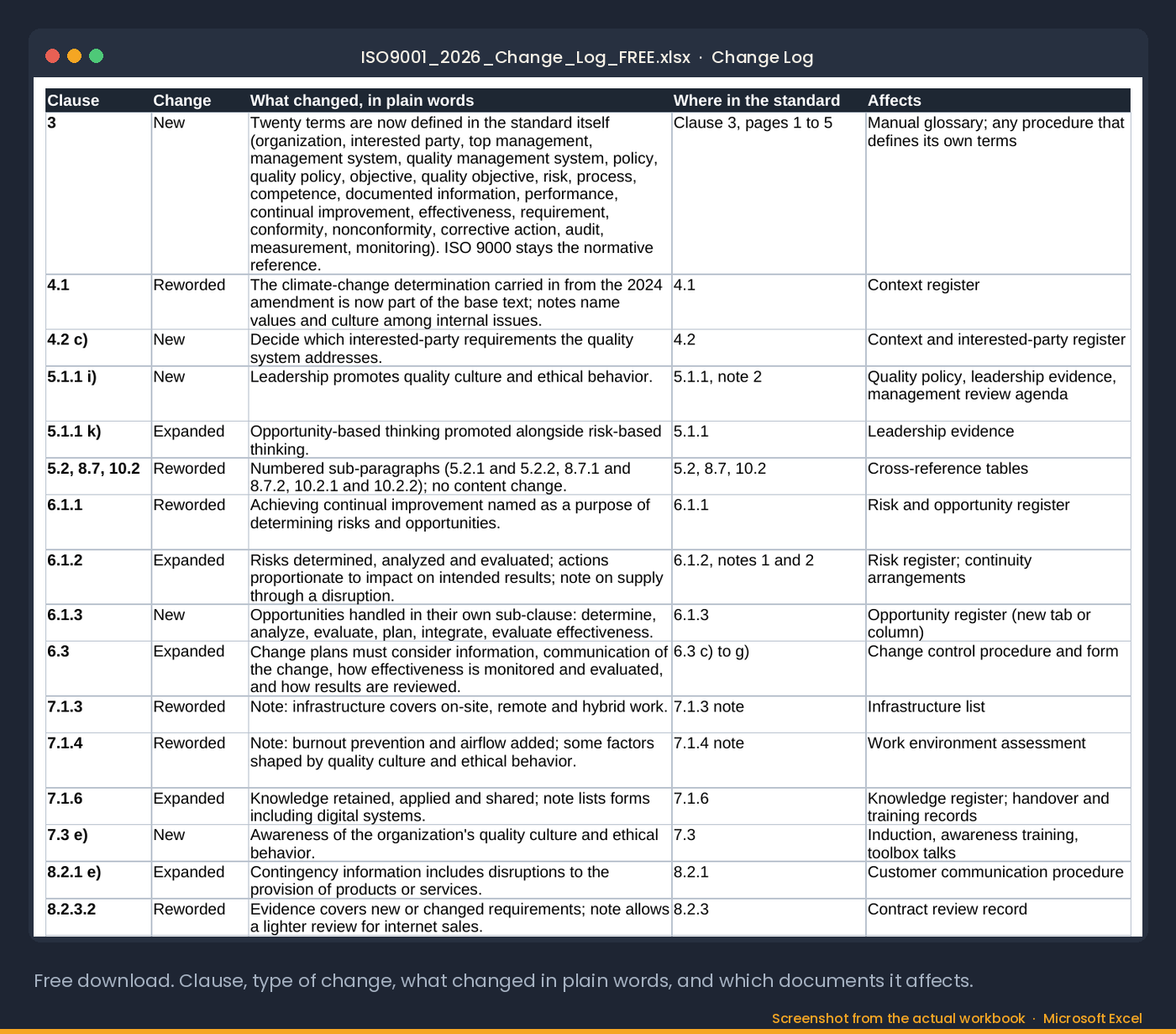
Twenty core terms are now defined in the standard itself: organization, interested party, top management, management system and quality management system, policy and quality policy, objective and quality objective, risk, process, competence, documented information, performance, continual improvement, effectiveness, requirement, conformity, nonconformity, corrective action, audit, measurement, monitoring. ISO 9000 stays the normative reference for everything else.
Affects: Manual glossary; any procedure that defines its own terms
Clause 4 — Context of the organization
4.1Expanded
The climate-change sentence from the 2024 amendment is now base text: decide whether climate change is relevant to you. The notes widen the example issues: political and environmental issues outside, strategic direction and resources inside.
Affects: Context register
4.2 c)New
Decide which interested-party requirements the quality system will address, not only which parties and requirements are relevant. The climate note from the 2024 amendment stays.
Affects: Interested-party register: add an "addressed by the QMS" column
4.3Reworded
Same three inputs, restructured: name the product and service types covered, justify each requirement you treat as not applicable, and keep the scope available as documented information.
Affects: Scope statement
4.4Reworded
The process list is renumbered a) to i) and now starts with determining the processes and where they apply. 4.4.2 is restated in the new documented-information wording: information to run the processes, and evidence they ran as planned.
Affects: Process map; procedure cross-references
Clause 5 — Leadership
5.1.1 i)New
Top management promotes quality culture and ethical behavior. A new note says both show up in what people value, how they behave and what they actually do.
Affects: Quality policy; leadership evidence; management review agenda. What the requirement is and what counts as evidence.
5.1.1 j) to l)Expanded
The list is reordered to a) to l). Opportunity-based thinking is promoted alongside risk-based thinking (a new phrase), "continual" is added to promoting improvement, and accountability for the system moves to the last item.
Affects: Leadership evidence; cross-reference tables
5.2.1Reworded
The policy is "established" here; implementing and maintaining it move to 5.2.2. Context and strategic direction become their own item e), and the commitment is to "meet" applicable requirements.
Affects: Quality policy
5.2.2 d)New
The policy must be put into practice, understood and followed inside the organization, not only communicated.
Affects: Awareness records; policy deployment evidence
5.3 e), f)Expanded
Reporting improvement opportunities to top management is now its own assigned duty, split from performance reporting. Keeping the system whole is required "including" when changes are planned and implemented. Processes must deliver intended results, not outputs.
Affects: Role descriptions; management review agenda; change control
Clause 6 — Planning
6.1.1Reworded
Determination of risks and opportunities keeps its shape; the purposes are reordered and continual improvement is named as one of them.
Affects: Risk and opportunity register
6.1.2Expanded
Risks get their own sub-clause. They are determined, analyzed and evaluated, actions planned and integrated, and the actions checked for effectiveness. Actions must be proportionate to the potential impact on the intended results of the system. A note says risks include keeping supply going during and after a disruption.
Affects: Risk register; continuity arrangements. Why 6.1 was split, and how to rebuild the register.
6.1.3New
Opportunities get their own sub-clause with the same steps: determine, analyze, evaluate, plan, integrate, evaluate effectiveness. Actions must fit your context and help reach the results you want.
Affects: Opportunity register: a new tab or a column that keeps them apart from risks. What an auditor asks for under 6.1.3.
6.2Reworded
The objectives list runs a) to h); keeping objectives as documented information is now an item in the list rather than a separate sentence.
Affects: Objectives record
6.3Expanded
Planning of changes now states its purpose, that changes are implemented effectively and reach their intended results, and adds three considerations: how the change is communicated, how you will monitor and judge whether it worked, and how you will review the results afterwards. Availability of information joins availability of resources.
Affects: Change control procedure and form
Clause 7 — Support
7.1.3Reworded
The note now says infrastructure applies to all types of work: on site, remote or a mix.
Affects: Infrastructure list
7.1.4Expanded
The social, psychological and physical factors are the same. The note adds that quality culture and ethical behavior can shape some of them.
Affects: Work environment assessment
7.1.5Reworded
7.1.5.2 is retitled "traceability of measurement results". Equipment is labeled so its calibration or verification state can be told, and the unfit-equipment sentence is restructured: when equipment is found unfit, decide whether earlier results were affected.
Affects: Calibration procedure
7.1.6Expanded
Knowledge must be retained, applied and shared, and it is tied to the intended results of the system, not only to product conformity. The note lists the forms it takes, including digital systems.
Affects: Knowledge register; handover and training records
7.2Reworded
Competence is what affects the performance of the system. Evidence in the new documented-information wording.
Affects: Competence matrix
7.3 d), e)New
Relevant quality objectives move to d). New e): awareness of the quality culture and ethical behavior the organization expects.
Affects: Induction; awareness training; toolbox talks. The three answers a machinist gives.
7.5.3Reworded
Evidence of conformity is "available" rather than "retained". The controls themselves are unchanged.
Affects: Document control procedure. The document control checklist lists the eleven references to search for.
Clause 8 — Operation
8.1Reworded
The planning list is restructured: acceptance criteria for products and services and criteria for the processes are separate items, and documented information becomes two standalone sentences. "Outsourced processes" becomes externally provided processes, products or services relevant to the system, which must be controlled.
Affects: Quality plans; operational procedures
8.2.1 e)Expanded
Contingency information now includes what happens if supply is interrupted. A new note lists the routes customer communication can take, from meetings to social media.
Affects: Customer communication procedure
8.2.3Reworded
The review happens before committing to supply; requirements "defined" by the customer replace "specified"; when the customer gives no written statement, confirm the requirements before acceptance. Evidence covers the review and any new or changed requirements.
Affects: Contract review record
8.2.4Reworded
When requirements change, the related documents are brought up to date and the people and parties concerned are told.
Affects: Change notification
8.3.1, 8.3.3Expanded
New notes: design can be iterative, and inputs are not always fully known at the start. Inputs must be complete, unambiguous and adequate.
Affects: Design and development procedure; design input records
8.3.2 g), 8.3.5 d)Expanded
Customers and other parties that matter are involved in design planning (was: users). Outputs must include the accompanying information a user needs, including whatever makes provision safe and correct.
Affects: Design outputs; labels; instructions
8.3.4, 8.3.6, 8.4.1, 8.4.2, 8.6, 8.7Reworded
Documented-information wording throughout; changes are "determined" rather than "identified"; outsourced processes now "are" inside the control of the system; 8.7.1 restructured to cover problems found after delivery or during a service. No new requirements.
Affects: Cross-reference sweep
8.4.3 d) to f)Expanded
Requirements to external providers now cover how the provider deals with your own customers and other parties that matter, how you control and watch provider performance, and verification at the provider's premises or another location.
Affects: Purchasing requirements
8.5.1, 8.5.2Reworded
Work documents must be used, not just available. Identification and traceability is rewritten as a list a) to d) with the same requirements.
Affects: Work instructions; traceability procedure
8.5.3Expanded
The note names premises, intellectual property and personal data as kinds of customer or provider property.
Affects: Customer property register; data protection controls
8.5.6Expanded
The change record must show who authorized the change and any follow-up actions, as well as the review results.
Affects: Production change record
Clause 9 — Performance evaluation
9.1.1Reworded
Methods "as applicable"; evidence in the new wording.
Affects: Monitoring and measurement plan
9.1.2Expanded
Monitor customer satisfaction and decide how the information is gathered, watched and reviewed. The note lists sources, adding feedback after delivery, customer meetings, dealer reports and social media.
Affects: Customer satisfaction method; data pack
9.1.3 e), f)Expanded
The effectiveness of actions on risks and the effectiveness of actions on opportunities are separate evaluation items; the effectiveness of planning implementation is its own item.
Affects: Analysis report; management review data pack
9.2.2Expanded
The audit programme is its own sub-clause. Audit objectives are defined for each audit alongside criteria and scope, and results go to the relevant managers.
Affects: Audit plan template; Internal Audit Program Kit tab 2
9.3.2 c)New
Management review input: changes in the needs and expectations of interested parties relevant to the system.
Affects: Management Review Pack agenda item 2 and data pack
9.3.2 e), g), h)Expanded
Opportunities for improvement move up the input list, and the effectiveness of risk actions and of opportunity actions are two separate inputs. The performance sub-list is reordered with nonconformities first.
Affects: Management Review Pack agenda item 10; data pack order. The two effectiveness inputs explained.
9.3.3Reworded
Outputs are now "results", stated in one sentence. The three decision areas are unchanged.
Affects: Minutes template
Clause 10 — Improvement
10.1Expanded
Continual improvement moves here from 10.3 and absorbs the old general clause. It must be fed: what the monitoring data, the analysis and the management review show is used to find opportunities, and the opportunities are acted on. Actions must include improving processes, products and services; addressing future needs and expectations; fixing, heading off or reducing unwanted effects.
Affects: Improvement procedure; management review results. The full clause 10 read: what changed and what an auditor asks for.
10.2Reworded
Complaints move from the opening sentence to a note as one source of nonconformities. "Reviewing and analyzing" becomes reviewing. Evidence in the new wording.
Affects: Nonconformity and corrective action procedure
10.3Removed
Merged into 10.1. Every procedure, checklist and audit report that cites 10.3 now points at nothing. Why 10.3 is gone, and what to put in its place.
Affects: Cross-references in the manual and procedures
Annexes and wording throughout
Annex BRemoved
The list of other ISO/TC 176 standards is gone; the pointers move into Annex A notes and the bibliography.
Affects: Manual references
ThroughoutReworded
"Retain" and "maintain" documented information are replaced by wording about documented information being available, or available as evidence. Annex A explains which is which. Records are still records.
Affects: Document control procedure wording
Annex AExpanded
Rewritten clause by clause, A.1 to A.10, and it now defines the words that cause arguments: appropriate versus applicable, consider versus take into account, continual versus continuous, ensure, strategic direction. It adds no requirements, but it is where interpretation arguments get settled.
Affects: Interpretation
What to do this week
Pull your certificate expiry date. If it falls inside the transition window, your recertification audit is your transition audit. That is your deadline, not 2029.
Ask your certification body when they can audit to the new edition. Auditors have to be trained and accredited first, and that takes most of a year. In the 2015 transition the slots ran out early. The people who asked first got them.
Read the changes against your system, not your manual. Culture, opportunities, change management — none of it is new work if you are already doing it. All of it is a finding if you only wrote it down.
Name one person to own the transition, with a dated plan top management has seen. "Someone is looking into it" is how a three-year window becomes a three-month scramble.
Score your own system in four minutes
The free readout asks thirteen questions about your system against these changes and gives you your readiness, your timeline to the deadline, and your first three actions. Nothing you enter leaves your browser unless you ask for the optional AI reading.
Run the free readoutThen do the work
This page is the short version of the book, ISO 9001:2026: What Changed, What Your Auditor Will Look For, and How to Close the Gaps (Kindle, paperback). The ISO 9001:2026 Gap Analysis & Transition Kit: the gap analysis with one row per sub-clause and the 2026 change already filled in, this change log with what each one touches, your evidence, gap, action, owner and due date with overdue flags, the transition plan dated from your own certificate, and the 2026 audit question bank. Read from the published text. $57.
Get the Transition KitEverything in the kit, tab by tabThe book, on AmazonSee all toolkitsQuestions
What is the current version of ISO 9001?
ISO 9001:2026, the sixth edition, published on September 16, 2026. It replaces ISO 9001:2015 and the 2024 climate amendment. Certificates to the 2015 edition stay valid through the transition window, expected to close around September 2029.
Is ISO 9001:2015 still current in 2026?
No. ISO 9001:2015 was withdrawn on September 16, 2026 when the 2026 edition published. Your 2015 certificate remains valid until the end of the transition window, but audits move to the 2026 text as certification bodies are accredited, expected through mid-2027.
When was ISO 9001:2026 published?
On September 16, 2026, as the sixth edition of the standard. ISO 9001:2015 and its 2024 climate amendment were withdrawn the same day.
How long is the transition period?
The IAF has indicated a three-year window, to approximately September 2029. Your certification body sets the detail. If your recertification audit falls inside the window, that audit is your transition audit and your real deadline.
Do I need a new certificate?
Yes. Every ISO 9001:2015 certificate has to be transitioned to the 2026 edition through an audit against the new requirements. Certificates to the 2015 edition stop being valid at the end of the transition window.
What are the biggest changes in ISO 9001:2026?
Quality culture and ethical behavior are now explicit requirements under leadership and awareness. Risks and opportunities are handled in separate sub-clauses, each requiring analysis, evaluation and an effectiveness check. Change management is strengthened. Clause 10 is renumbered. Twenty core terms are defined in the standard itself. Annex A is expanded and Annex B removed.
Did the clause numbers change?
Mostly not. The big exception is clause 10: continual improvement is now 10.1 and absorbs the former general clause, and 10.3 no longer exists. Sub-clause 6.1 is split into 6.1.1, 6.1.2 and 6.1.3, and 9.2 into 9.2.1 and 9.2.2. Any procedure or audit checklist that cites the old numbers needs a sweep.