Quality Field Guides › Tools › Internal Audit Checklist & Findings Register
Internal Audit Checklist
ISO 9001:2026 internal audit checklist in Excel, written as the questions an auditor actually asks
The ISO 9001 Internal Audit Checklist and Findings Register — 95 questions by clause in the four shapes that get answers, each with a "look for" prompt; updated for ISO 9001:2026 with 21 questions on the new requirements; and a findings register that classifies (major, minor, observation, OFI), flags overdue items, and tracks correction, corrective action and effectiveness verification separately. $5+. One part of the Internal Audit Program Kit, which adds the risk-weighted annual program, audit plans, closure verification and management review reporting.
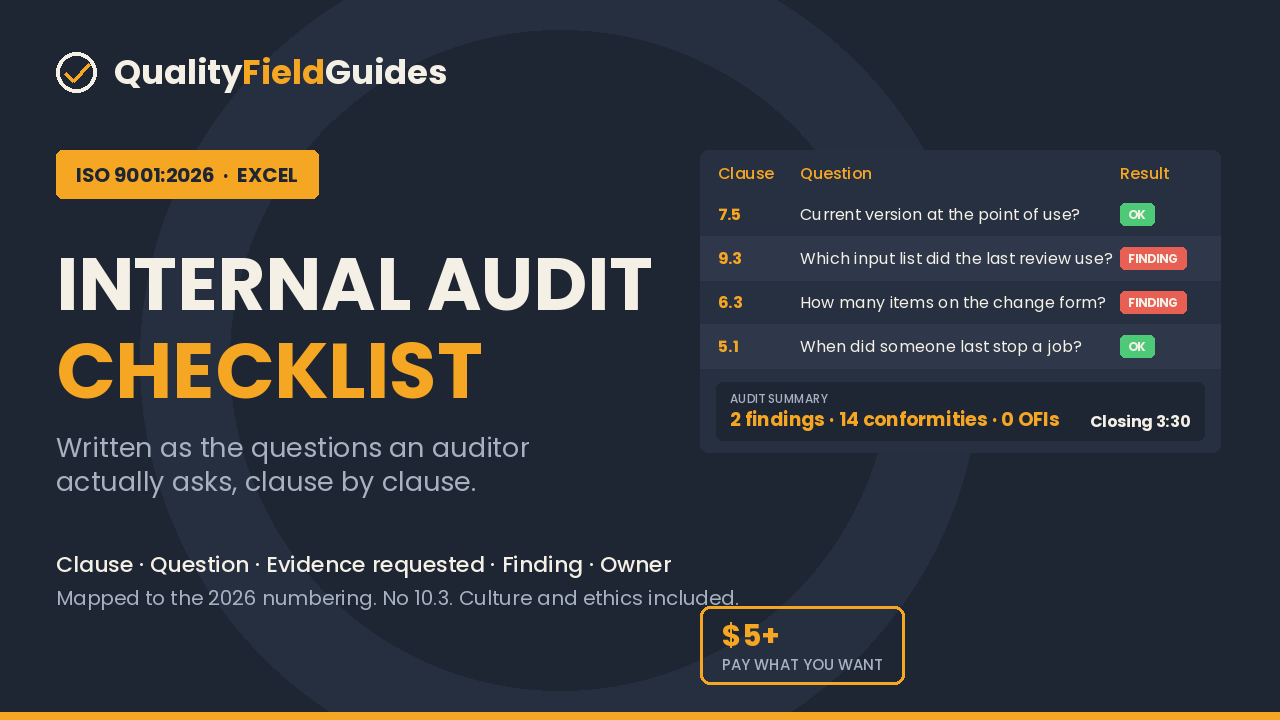
$5 minimum, pay what you want.
Get the Excel fileEntry worksheet · $5 minimum, pay what you want · Excel 2016+ or Google Sheets · pre-filled with a worked example
This worksheet is the first tab of the Internal Audit Program Kit ($35).
30-day refund, no questions. Files are Excel (.xlsx); no macros.
See inside
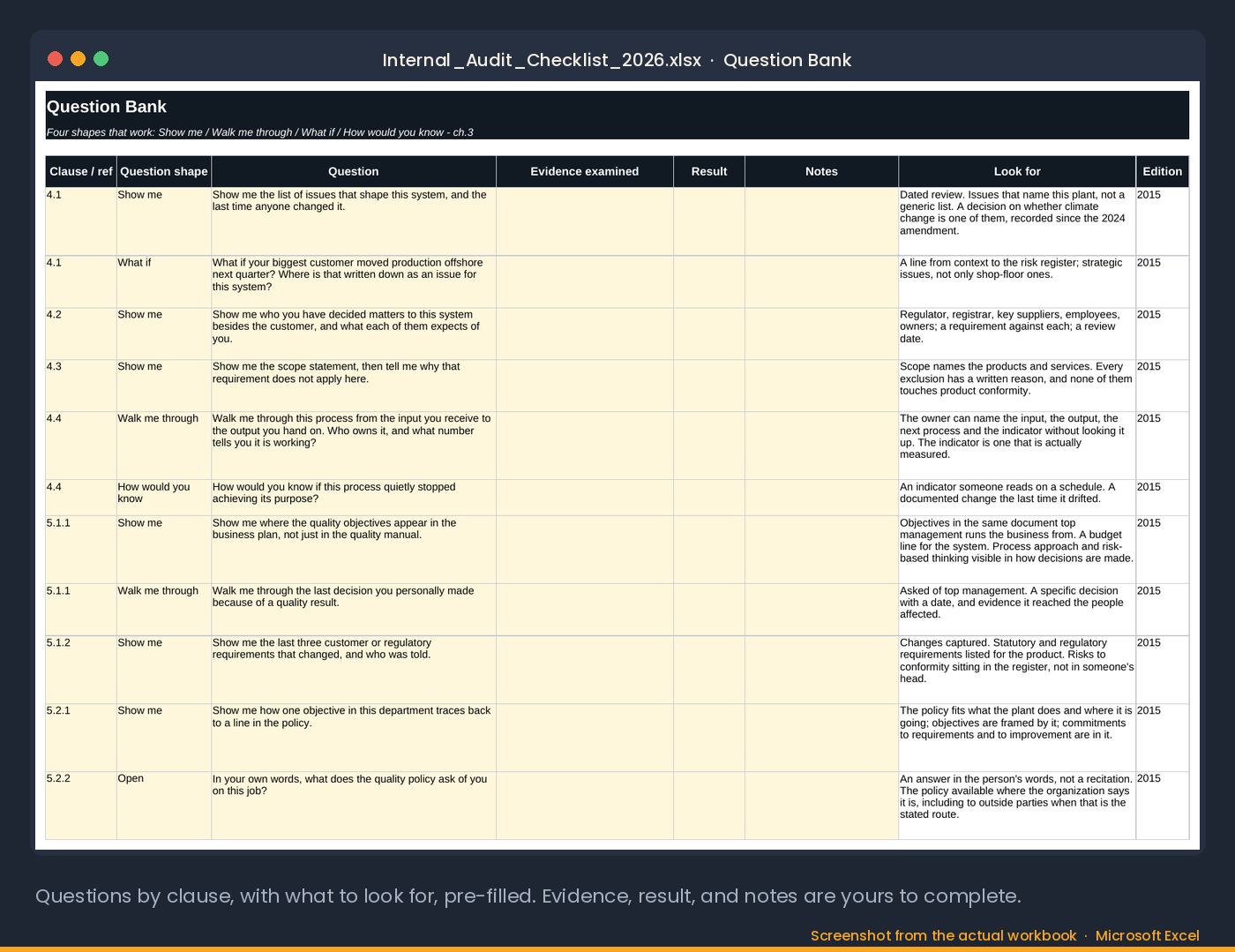
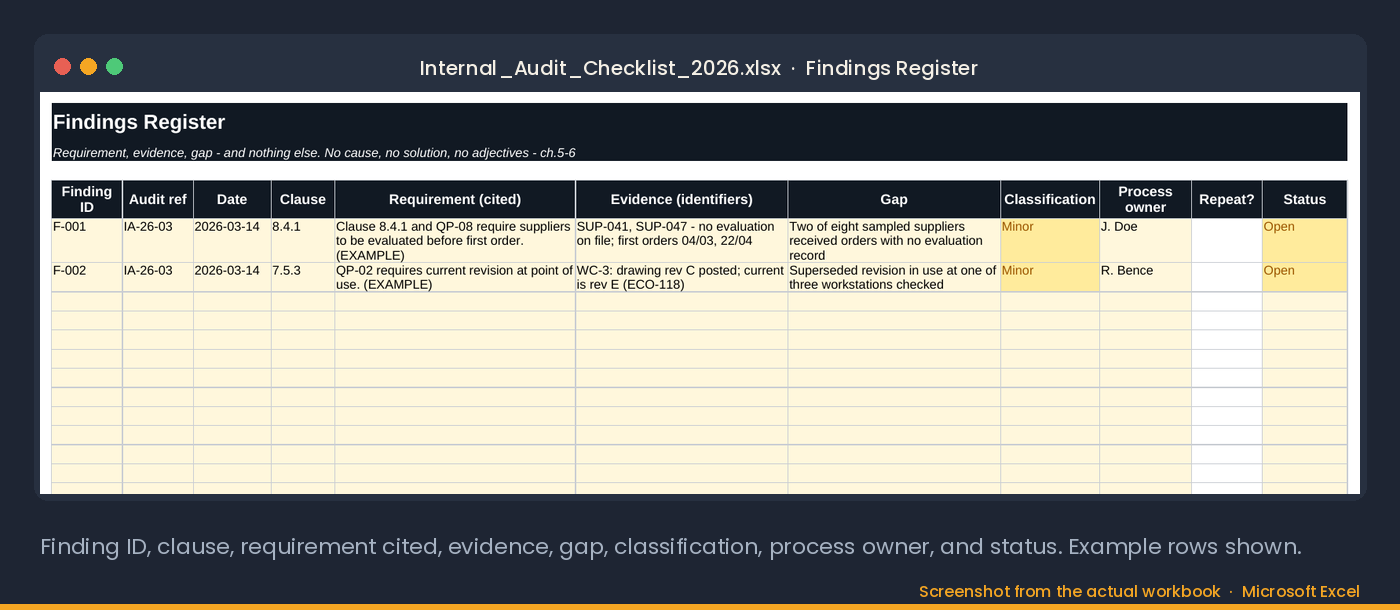
Screenshots from the actual workbook.
How this one is different
A checklist of yes-or-no questions produces a page of yeses. This one asks for evidence by clause, in the four question shapes that get answers, records what was sampled, and feeds a findings register that flags a repeat when the same clause was found before.
How to use it
- Pick the process and the clauses in scope for this audit on the plan tab.
- Work the question bank for those clauses; write the evidence seen, not a tick.
- Record each finding in the register with the clause, the type (major, minor, observation, OFI) and an owner.
- Watch for the REPEAT flag: the clause was found at the last audit and the fix did not hold.
- Track correction, corrective action and effectiveness verification as three separate columns, with days open.
- Take the register to management review as the audit results input.
Who it is for
For the quality manager or internal auditor running an ISO 9001 audit program, especially the first one against the 2026 edition. Not for a certification body auditor; it is the internal view.
30-day refund, no questions. Files are Excel (.xlsx); no macros.
The method
Four question shapes do most of the work.
"Do you have a documented procedure for calibration?" has one useful answer and one useless one, and you will almost always get the useless one. An internal audit checklist built from yes/no questions tells you nothing.
Ask instead: show me the calibration status of the last three instruments used on this process. Now you are looking at evidence rather than listening to a claim, and the answer tells you about records, labeling, recall discipline and point-of-use control at once. Four question shapes do most of the work. Show me — whether control reaches the point of work. Walk me through — the real sequence, including the undocumented steps. What if — whether the process depends on one person. How would you know — whether any detection exists at all.
The question that finds the most: ask people what they do that is not in any procedure. Asked without a clipboard, this produces more useful findings than any record sample. Every workaround someone describes is a place where the documented process failed to survive contact with the work. Be careful what you do with the answer — if describing a workaround gets someone's colleague written up, you will not get another honest answer in that building for years. Findings go against the process, never the person.
And classify honestly. Everything-is-an-OFI means the auditor avoided the difficult conversation. Everything-is-a-major means nobody takes the next one seriously. A minor raised for the third cycle running is not a minor; the pattern is the finding.
Read next: Internal Audit Program Kit · ISO 9001:2026, what changed · Management Review Pack
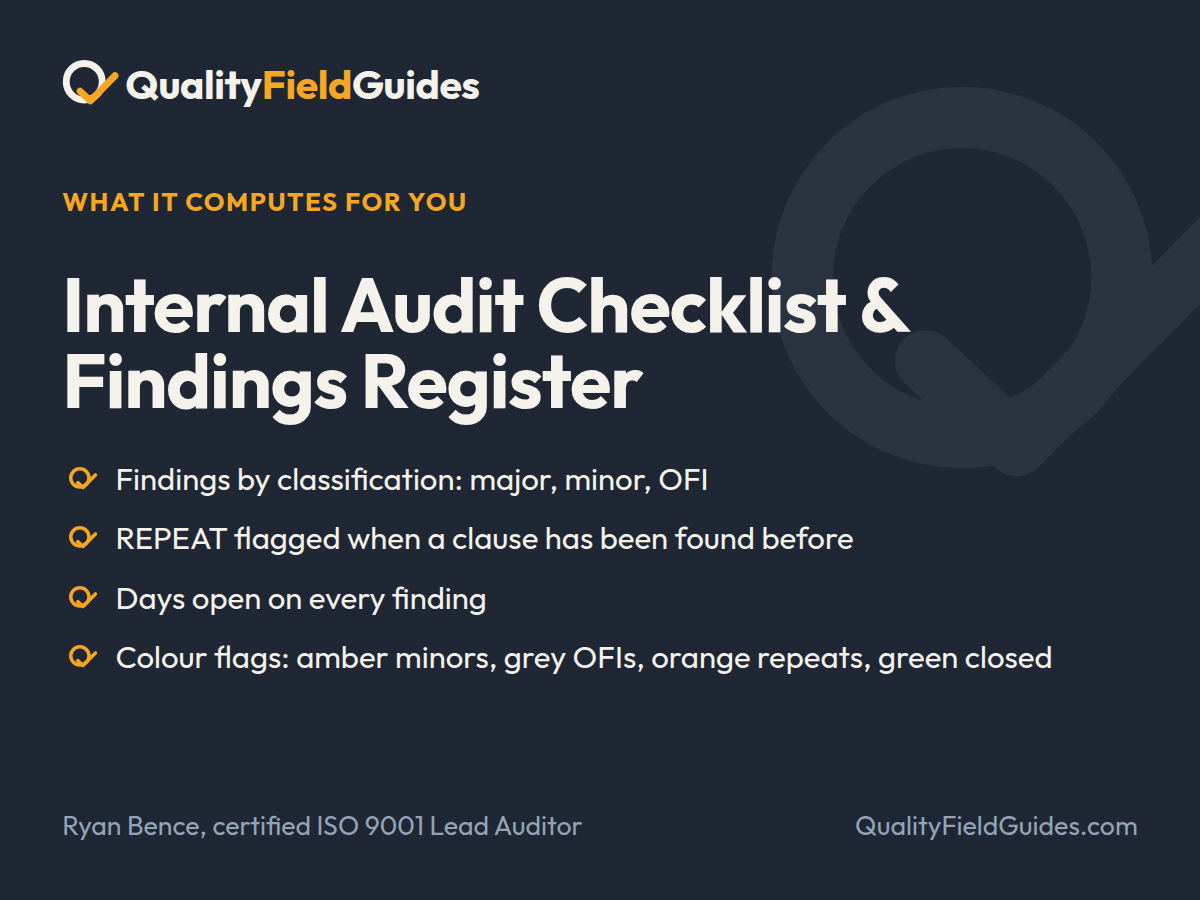
What it computes for you
The question bank and the findings register from the Internal Audit Program Kit. Ask the right questions, log what you find, watch the repeat flag.
- Findings by classification: major, minor, OFI
- REPEAT flagged when a clause has been found before
- Days open on every finding
- Color flags: amber minors, gray OFIs, orange repeats, green closed
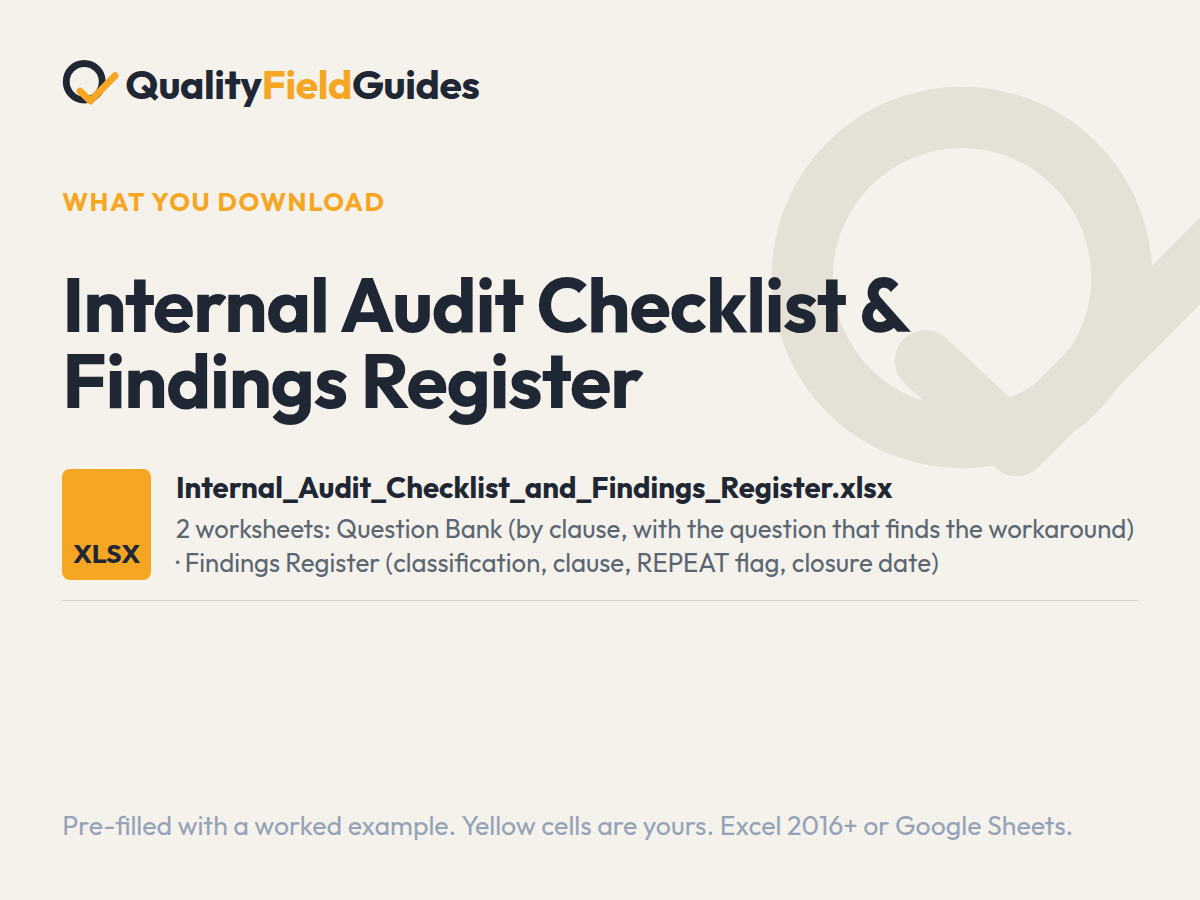
What you download
One file, three tabs.
Yellow cells are yours; white cells calculate. It arrives filled in with the series’ fictional plant so every flag and chart has something to show; clear the yellow cells and start.
Questions
Before you buy.
Is this checklist updated for ISO 9001:2026?
Yes — 21 questions flagged for the 2026 edition were added from the published text on publication day, alongside the 2015 questions that still apply through the transition. Nothing from the standard is reproduced; questions point to clause numbers.
How many questions should an internal audit use?
Fewer than you think. A traced job through every handoff finds more than sampling each department against a full list. Pick the questions for the process and the risk; the bank is a menu, not a script.
Which Excel version do I need?
Excel 2016 or later on Windows or Mac, or Google Sheets. Every formula is standard: no macros, no add-ins, no external links. In Google Sheets use File → Import → Replace spreadsheet.
Why does the workbook arrive filled in?
Every workbook ships pre-filled with the same fictional plant so each dashboard, flag and trend has something to show. Read it that way first, then clear the yellow input cells; the white computed cells empty themselves.
What is the difference between an entry worksheet and a pack?
An entry worksheet is two or three tabs lifted from its pack, and it is $5 or more, your choice. The pack is the full workbook with the register, the dashboard and the field guide PDF that explains the method, for $35. Start with the worksheet; the formulas and the worked example are the same.
What if it does not do what the page says?
Thirty days, no questions. Reply to the receipt email, or write to ryan@qualityfieldguides.com, and it is refunded.
Goes with it
The tools next to this one.
Internal Audit Program Kit
A risk-weighted audit program that flags repeat findings and reports its own verified-effective rate.
See what it computesManagement Review Agenda & Minutes
Thirteen required inputs, each with an owner and minutes against it, and a minutes sheet that records the conclusion, not the conversation.
See what it computes5 Whys & Cause Analysis Worksheet
A problem statement that survives the meeting, a five-whys chain that stops at a system, and a cause-scoring sheet that ranks what you found.
See what it computes