Quality Field Guides › Tools › 5 Whys & Cause Analysis Worksheet
5 Whys Template
5 Whys template in Excel, with an evidence column beside every why
The 5 Whys Template — the why-chain with an evidence column, the therefore test, and the one closing question: would fixing the cause you landed on actually have prevented the failure? $5+. It is one tab of the full Root Cause & Corrective Action Toolkit.
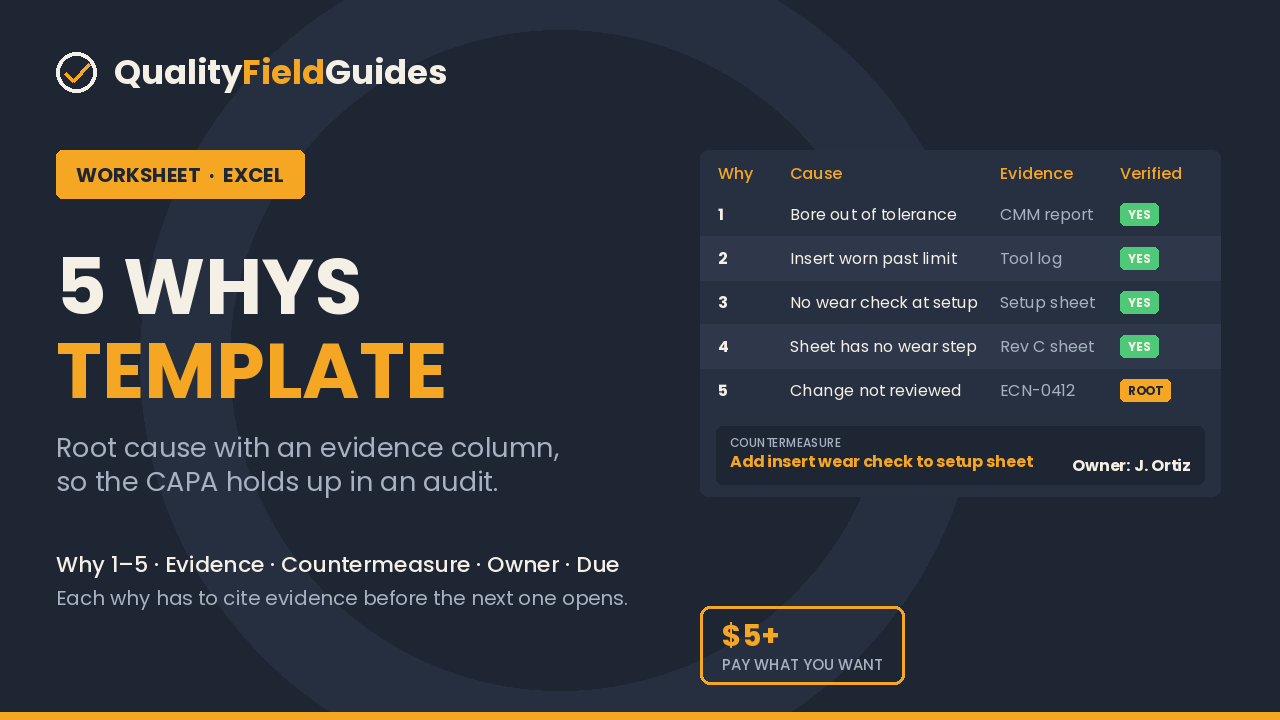
$5 minimum, pay what you want.
Get the Excel fileEntry worksheet · $5 minimum, pay what you want · Excel 2016+ or Google Sheets · pre-filled with a worked example
This worksheet is the first tab of the Root Cause & Corrective Action Toolkit ($35).
30-day refund, no questions. Files are Excel (.xlsx); no macros.
See inside
Screenshots from the actual workbook.
How this one is different
Most 5 whys templates are a diagram with five boxes. This one is a workbook: every why has a cell beside it for the evidence that link rests on, the chain is read back with the therefore test, and a third tab scores the candidate causes on evidence, mechanism and reach so the one you act on is the one the data supports.
How to use it
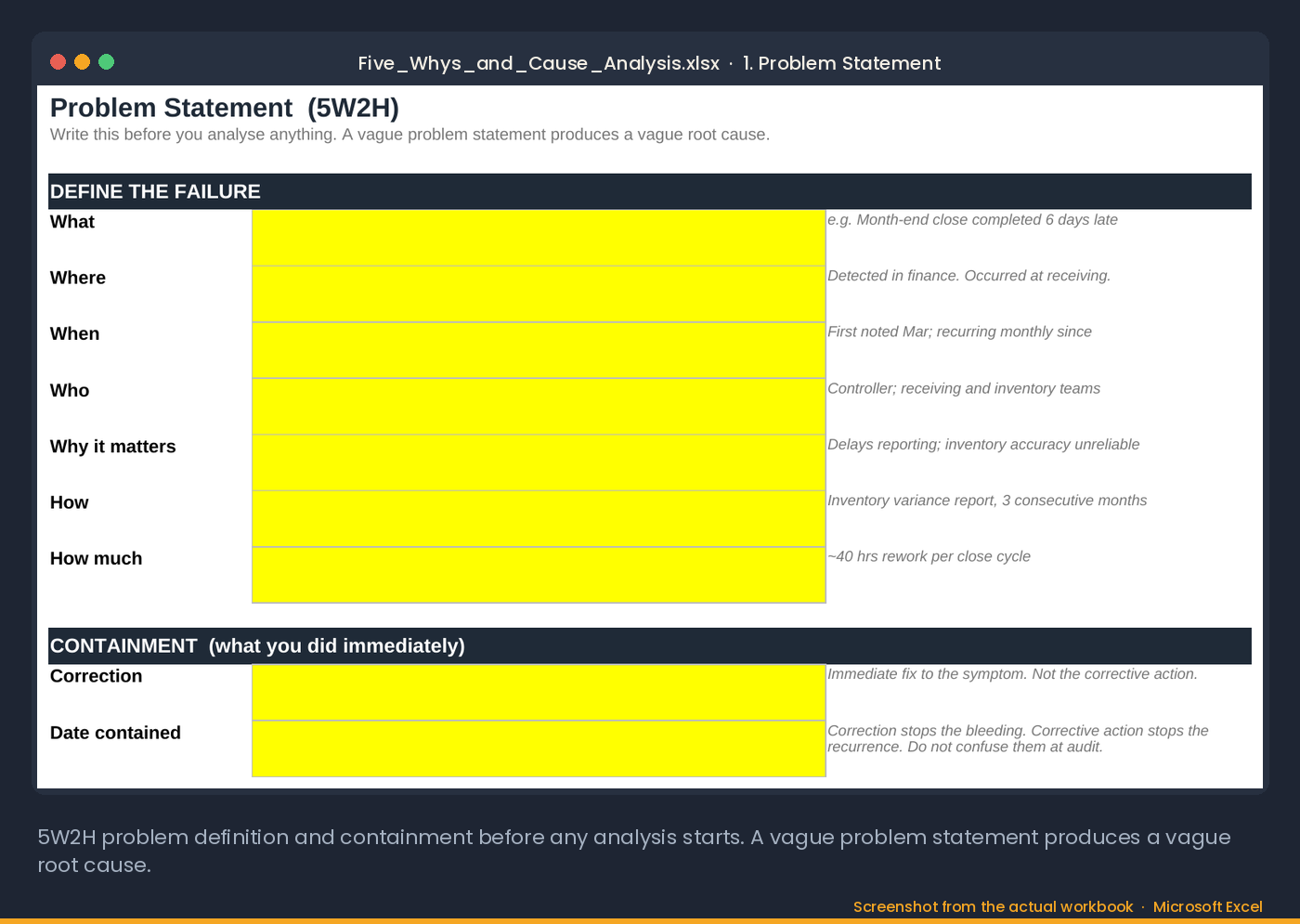
- Write the problem statement on tab 1: what, where, when, who, how you know, how much.
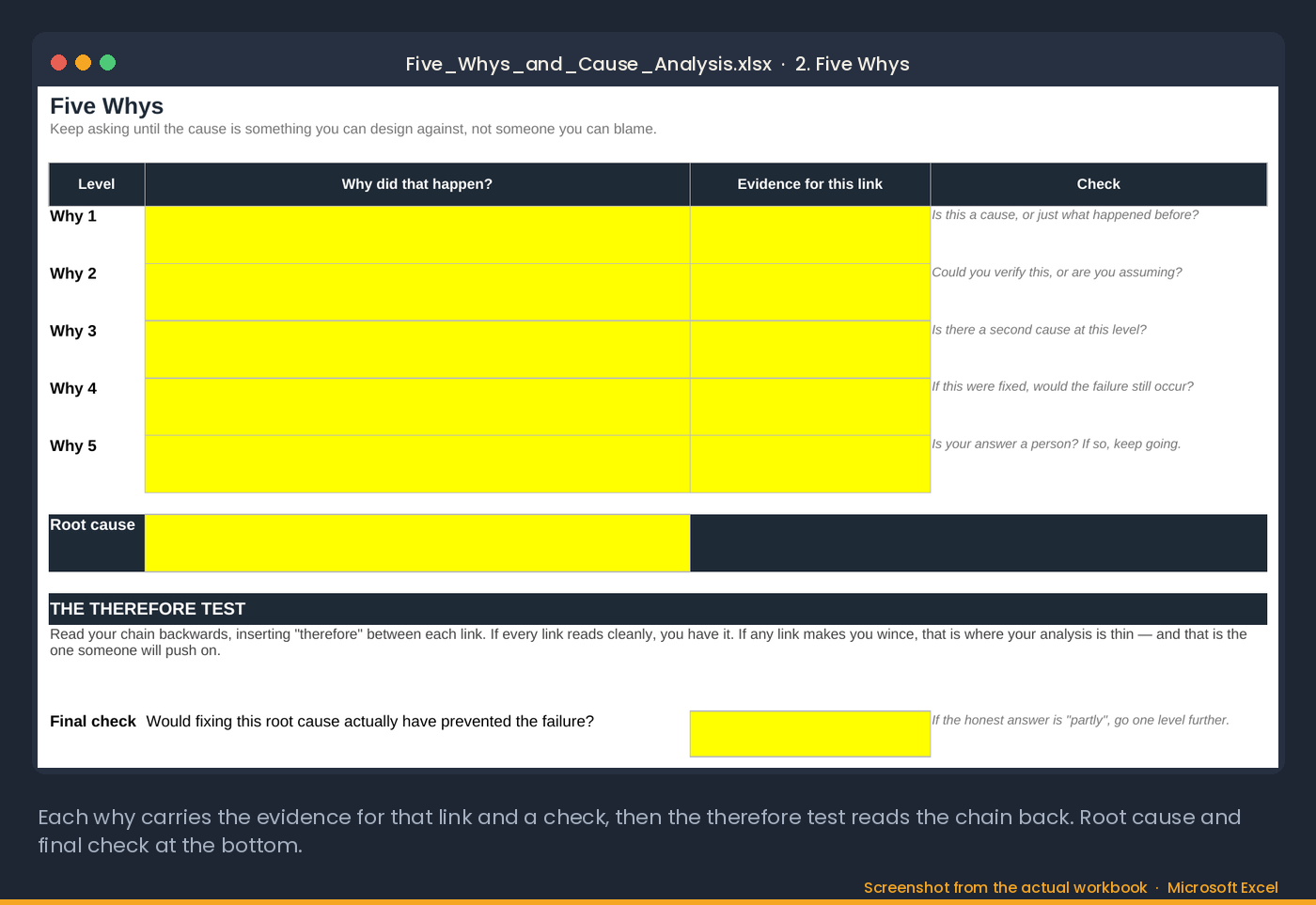
- On tab 2, answer the first why and put the evidence for it in the column beside it. No evidence, no link.
- Keep going until the answer is something you can design against, not someone you can blame. Five is a guide, not a rule.
- Read the chain backwards with "therefore" between the links. If it does not read cleanly, the chain is a story.
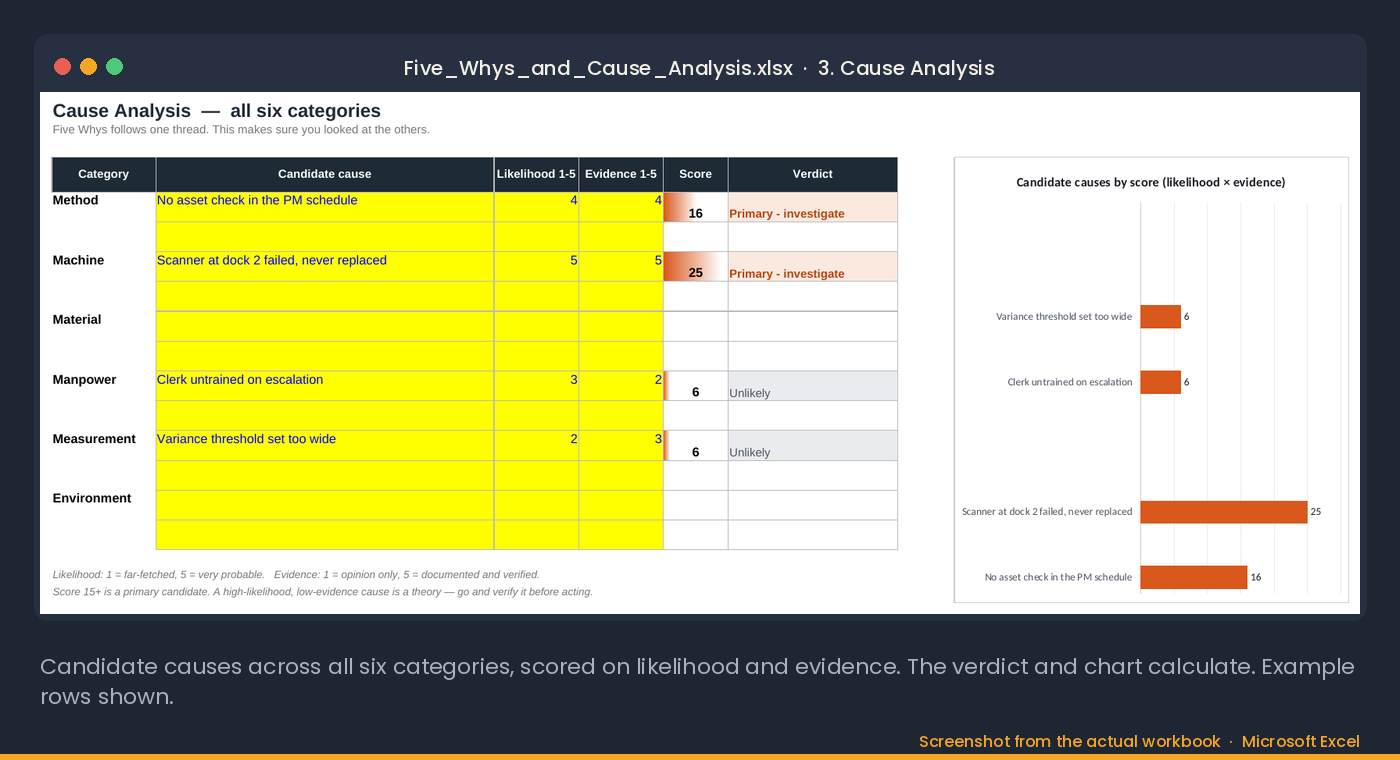
- Score each candidate cause on tab 3. The sheet ranks them.
- Carry the top cause into your corrective action record with the evidence column attached.
Who it is for
For a quality engineer, supervisor or team lead who has to close a nonconformity and show the reasoning. Not for a team that wants a whiteboard diagram; this is a record, not a workshop tool.
30-day refund, no questions. Files are Excel (.xlsx); no macros.
The method
Four failure modes show up in almost every chain.
The 5 whys technique is simple enough that everyone assumes they're doing it right. Four failure modes show up in almost every chain.
Stopping at a person. "Because the operator did not follow the procedure" is where most chains end, and it is a symptom. Why did he not? Was the procedure wrong, unavailable at the point of work, slower than the workaround everybody actually uses? Every one of those is fixable at a level that holds. A person's name is not.
Stopping where your authority stops. People stop at the level they can action, because going further produces a finding they cannot close. Record the real cause anyway. An unfixable finding documented is a business case waiting for a budget cycle.
Following one chain when there are three. Failures often have parallel causes. If your five whys is a single line, ask at each level whether anything else contributed.
Confusing sequence with causation. The thing that happened immediately before is not necessarily the cause. This is why a 5 whys template needs an evidence column — it is the difference between analysis and storytelling.
The therefore test: read your chain backwards, inserting "therefore" between each link. If every link reads cleanly, you have it. If any link makes you wince, that is where your analysis is thin — and that is the one somebody will push on.
Read next: Root Cause & Corrective Action Toolkit · The CAPA register in the full toolkit
Worked example
The dock-2 scanner case, start to finish.
This is the case the worksheet ships with, from the fictional plant that runs through every tool on this site. Read it once and the four failure modes above become easy to spot in your own chains.
1. Problem statement (5W2H)
| What | Month-end close completed six days late |
|---|---|
| Where | Detected in finance; occurred at receiving |
| When | First noted in March; recurring every month since |
| Who | Controller; receiving and inventory teams |
| Why it matters | Reporting is late and inventory accuracy is unreliable |
| How known | Inventory variance report, three consecutive months |
| How much | About 40 hours of rework per close cycle |
| Correction | Manual recount before close. Stops the bleeding; it is not the corrective action. |
2. Five whys, with the evidence column
| Level | Why did that happen? | Evidence for this link |
|---|---|---|
| Why 1 | The inventory variance report did not reconcile, and finance spent days chasing counts. | Variance report, three months running |
| Why 2 | Receiving quantities at dock 2 were keyed in by hand at the end of each shift, from paper tallies. | Receiving log: entries batched between 15:50 and 16:10, not at time of receipt |
| Why 3 | The barcode scanner at dock 2 failed in February and the clerk switched to manual entry. | No scanned receipts from dock 2 after February 18 |
| Why 4 | The failed scanner was never replaced. The clerk had no route to report equipment failure. | No work order raised; clerk not trained on escalation |
| Why 5 | Handheld equipment is not on the weekly PM asset check, so a dead scanner is nobody's job until a report breaks. | PM schedule lists fixed equipment only |
| Root cause | No asset check for handheld equipment in the PM schedule. | |
The therefore test, read backwards. No asset check in the PM schedule, therefore the failed scanner was never replaced, therefore receiving went to manual entry, therefore the variance report stopped reconciling, therefore the close ran six days late. Every link reads cleanly. The final check: would adding the asset check have prevented the failure? Yes, because the scanner would have been replaced the week it died.
Notice where a weaker chain stops: at Why 4, with the clerk. "Retrain the clerk" is the fix that would have been written, and the next scanner failure would have gone the same way.
3. Cause analysis across all six categories
Five whys follows one thread. The cause-analysis sheet scores the others so nothing was missed. Score is likelihood times evidence; 15 or more is a primary candidate.
| Category | Candidate cause | Likelihood | Evidence | Score | Verdict |
|---|---|---|---|---|---|
| Machine | Scanner at dock 2 failed, never replaced | 5 | 5 | 25 | Primary. What happened. |
| Method | No asset check in the PM schedule | 4 | 4 | 16 | Primary. Why it stayed broken. |
| Manpower | Clerk untrained on escalation | 3 | 2 | 6 | Contributing |
| Measurement | Variance threshold set too wide | 2 | 3 | 6 | Contributing |
| Material | None found | ||||
| Environment | None found |
Two primaries is the normal result. The machine cause is the event; the method cause is the condition that let it persist. The corrective action has to address the second one, or the fix expires with the next failure.
Download the 5 whys template
Three tabs: this problem statement, the five-whys sheet with the evidence column and the therefore test, and the cause-analysis scorer. Excel 2016 or later, or Google Sheets. It arrives with this case filled in, so you can read it before you clear it.
Get the template on Gumroad, $5+What it computes for you
A problem statement that survives the meeting, a five-whys chain that stops at a system, and a cause-scoring sheet that ranks what you found.
- Candidate causes scored and ranked automatically
- A verdict on each cause: root cause, contributing, or symptom
- The guide's worked example already filled in (the dock-2 scanner case)
- If the last answer is a person's name, you have not found a root cause
What you download
One file, three tabs.
Yellow cells are yours; white cells calculate. It arrives filled in with the series’ fictional plant so every flag and chart has something to show; clear the yellow cells and start.
Questions
Before you buy.
How do you perform the 5 whys?
Write a problem statement first, with what, where, when, who, how you know and how much. Then ask why the problem happened, write the answer, and write the evidence for that link beside it. Ask why of the answer, five times or until the cause is something you can design against rather than someone you can blame. Read the chain backwards with therefore between the links; if it reads cleanly, you have it.
What are common mistakes when using 5 whys?
Stopping at a person, accepting a link without evidence, following one thread and never checking the other five categories, and fixing the cause at the level of training or procedure when a design or detection control was available. The worksheet has a column or a check for each of these.
Is there a 5 whys example in the template?
Yes. The worksheet arrives filled in with the dock-2 scanner case shown on this page: a late month-end close traced through manual receiving entry to a failed scanner that was never replaced because handheld equipment was not on the PM asset check. Clear the yellow cells and it is ready for your own case.
How many whys do you actually need?
As many as it takes to reach something you can change at the system level. Five is a guide, not a rule; three is often enough, seven is not unusual.
What's the difference between this and a free 5 whys template?
The evidence column and the closing question. Free templates let you write a plausible story; this one makes you show your working.
Which Excel version do I need?
Excel 2016 or later on Windows or Mac, or Google Sheets. Every formula is standard: no macros, no add-ins, no external links. In Google Sheets use File → Import → Replace spreadsheet.
Why does the workbook arrive filled in?
Every workbook ships pre-filled with the same fictional plant so each dashboard, flag and trend has something to show. Read it that way first, then clear the yellow input cells; the white computed cells empty themselves.
What is the difference between an entry worksheet and a pack?
An entry worksheet is two or three tabs lifted from its pack, and it is $5 or more, your choice. The pack is the full workbook with the register, the dashboard and the field guide PDF that explains the method, for $35. Start with the worksheet; the formulas and the worked example are the same.
What if it does not do what the page says?
Thirty days, no questions. Reply to the receipt email, or write to ryan@qualityfieldguides.com, and it is refunded.
Goes with it
The tools next to this one.
Root Cause & Corrective Action Toolkit
Seven worksheets from problem statement to verified, closed CAPA, with a 90-day effectiveness check.
See what it computesCost of Poor Quality Calculator
Put a number on the problem nobody is fixing. Labor, error and opportunity cost, with a confidence haircut finance will accept, and a verdict on whether the fix pays back.
See what it computesInternal Audit Checklist & Findings Register
The question bank and the findings register from the Internal Audit Program Kit. Ask the right questions, log what you find, watch the repeat flag.
See what it computes